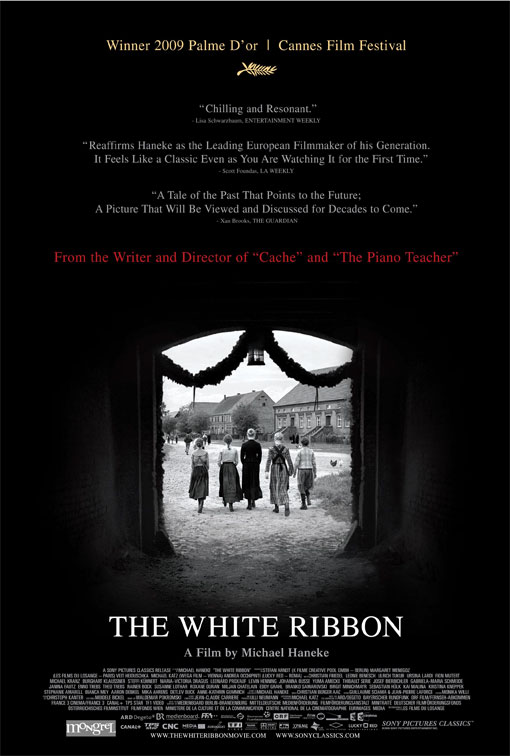
The White Ribbon is a quiet and disturbing allegory set in a farming village in the rural Germany just some years before the World War I. The director Michael Heneke, known for his patient, methodological and detached style of filmmaking, tells a story of an array of strange events, accidents and murders that led to distrust and fear within the seemingly peaceful community.
The film is narrated by an unnamed school teacher in his old age now, recalling these strange events that happen in the village during his stay long time ago. The village is quiet and orderly, half of the habitants work for the baron who owns most of the land. At the beginning the village doctor was injured when his horse was tripped by a wire purposely set by someone. Accident happened in the barn which was burned later. Violence and tortured were exercised on some kids. Who was responsible? There are some hints, the truth seems palpable but we are never sure.
The fear of suspicion grows within the community as well as in us. We are given as little information as the characters receive. Can we trust the characters? There is no real emotion beyond their zombielike faces. Expression of oneself seems impossible within the power structure of this miniature society. Those who have spoken their own thoughts are considered threatening and are threatened by other members. Our only trustee is the school teacher. A hint of human touch occasionally flashes upon his face, and especially in his relationship with the baron's babysitter Eva. By the end of the film, there is no revelation of the looming villain, and that is beside the point of the film. The protagonist is the social dysfunction and the dread of living in it.
One might connect the story to the Nazi and fascism, but the film is really about a monarchy and the rebellion. The village is ruled by the riches - the baron, the pastor and the doctor. Under their rules, the villagers have no choice but to submit to their power. There is no escape, at least that's what the isolating landscape suggests. Those who choose to rebel are dysfunctional, sick or sinned, said the pastor and doctor. What is lurking behind the seemingly peaceful life is a savage revolution against the throne, using method inherited from the seniors.
This is a rare branch of film that is not set out to be liked or disliked. It intends to be appreciated like an essay or experiment. It asks you to confront a problem without giving away any solution. The film simply illustrates a situation like a bare fact. It won't work without the stunning black and white photography, which immediately separates its world from ours, creating a sense of detachment. Like his previous film Caché, Michael Heneke created a long and painfully slow film that absorbs you into its scenery and atmosphere, that is if you sit tight all the way until the end.
T.

沒有留言:
張貼留言