2010年4月27日 星期二

A Serious Man


A Serious Man is a seriously funny and well-crafted film about a Jewish physics professor named Larry Gopnik whose life is falling apart for no obvious reason. His wife is leaving him for his best friend Sy Ableman (brilliantly played by Fred Melamed), his children neglecte him, a Korean student of his class tries to destroy him by leaving bribe money on his desk, his leech brother keeps running into trouble. Why? There is no reason and it only gets worse.

Larry wants to be taken as a serious and respectful man. He hasn't done wrong and that is the funny part. It just looks like God doesn't like him and decides to pull some pranks on him. We watch him searching for an answer to all these disasters going on in his life, and we laugh because we know there is no answer to it. He consults the Rabbis and none of them even takes him seriously. Larry lives in a world of numbers and equations. In his world even uncertainly can be understood with a mathematical equation, and the problem is in life there is no equation!

One of the funniest scenes of the movie is about a Jewish dentist finding a Hebrew phrase "Help me" engraved on the teeth of a gentile patient. The other scene involves Rabbi Marshack, rabbi of the highest rank, quoting a line from the Jefferson Airplane's song during a meeting with Larry's son Danny after his graduation ceremony. If you can find these scenes funny then this is your movie.

The things I love most from the Coen Brothers' consistent work are the clarity of the script and the inhuman and detached look of their characters. A Serious Man is a movie that you can enjoy because you are so detached from the characters that you can laugh at them from God's point of view. The perfection is up to the standard of Stanley Kubrick only the jokes are instantly accessible. The movie works like a Michael Heneke movie with a perfect punch line.

This is one of the finest movies from the Coen Brothers. It has all the trademarks of their best movies: the odd characters, wonderfully twisted jokes, perfectly thought out script, etc. Unlike Fargo or No Country for Old Man, A Serious Man is a pure comedy (if you can call it) that sets out to laugh at the stupidity of a man who thinks life is certain and manageable, whereas it is the opposite in the universe of a Coen Brothers' movie.

T.


2010年4月23日 星期五

IGO - Synth Love


中國內地underground音樂一直發展蓬勃,
可惜沒怎樣主動去接觸過。
直至去年在上海認識了IGO,
那震憾難以形容,
當然,“中國”是因素之一。

IGO是來自上海的synthpop組合,
由JJay做主音、作曲、programming,
B6負責電子、programming、視覺和製作,
一個由美國留學歸來,
一個是上海夜店著名DJ,
碰面發覺大家都愛Depeche Mode、Kraftwerk和Röyksopp等,
於是決定組成樂隊。

第一次接觸IGO是,
絕對不可能認出這是來自中國的音樂,
他們做的是純synth,
喜歡電音的會很滿足。
而唱的部分卻沒有怎樣的混音,
我會視為偏new wave的pop,
沒有半點的膩。


Album: Synth Love
Year: 2006
Country: China
Genres: Synthpop
My Fav: Holy Mood

作為Debut album,
這表現實在沒有什麼可以挑剔,
也許聽Petshop Boys和Depeche Mode太多了,
少了皮膚和腦袋的刺激,
而IGO的synth music很是簡潔,
恰到好處的synth現在好難找。

還有,主音的嗓子蠻順耳的,
不是絕對零度的冰冷,
很懂侵入腦袋。


IGO - Rockself Dot Com

kaho

2010年4月18日 星期日

The Fountainhead - Triumph of the Ego


The Fountainhead is one of the most renowned work of Ayn Rand about a young struggling individualistic architect named Howard Roark and his crusade against an emerging collectivism movement led by the corrupted intellectual Ellsworth Toohey. The book speaks especially well to aspiring designers, architects, artists or anyone in the creative sector. The issues raised by the book must one way or the other occur during a creative career of any kind.

Roark's modernistic approach to architecture is at the time when the academia and public still favor the classical motif over modernism. He is expelled from the Stanton Institute of Technology for his refusal to accept the outdated tradition of the school. His schoolmate Peter Keating becomes an immensely successful and nonetheless vacuous architect ready to give the public what they want without resentment. The story revolves around the careers of the two architects, following a chain of events that ultimately leads to the clash of individualism and collectivism.

Ellsworth Toohey is the opposite of everything Roark represents. He gives public speeches on selflessness, altruism and the "collective brain". He controls a small but important circle of members from different social and professional sectors which are part of a larger circle. While Roark triumphs the human spirit and treasures the ego of a man, Ellsworth sets out to control men by destroying the concept of the self. He believes by destroying the self, one can only be fed on the opinions of others, becoming helplessly obedient to any kind of authority. He writes a small but reputable column on Banner, an obscene newspaper owned by Gail Wynand who acquires wealth and power by all capitalist means.

Born in Russia and immigrated to the United States in 1926, Rand's philosophy Objectivism emphasizes the importance of individual rights over collectivism and statism. The book encapsulates Rand's political view through the intricate ideological battle between the self and selflessness, the egoist and collective brain, the creator and the second-hander (or parasite as Roark calls it). In this sense Ellsworth Toohey is the enemy of individualism, he is the epitome of all form of statism such as communism and fascism. Like parasite, living on the opinions of others is more convenient than retaining rationality and individuality. Toohey's method is only a trigger to that weakness. Once it becomes epidemic, one lever will control all mechanism of a society. And a man like Howard Roark is a danger to this society for he cannot be controlled in the absolute sense.

This book reads like a personal meditation to me. I spent my college years in a design program that promoted social responsibility over individuality. This would easily destroy the last trait of individuality of an aspiring designer still yet to be launched to the world. I recommend this to all of you fellow aspiring designers. This book will fight with you in your quest for creative freedom and artistic integrity.

T.

2010年4月11日 星期日

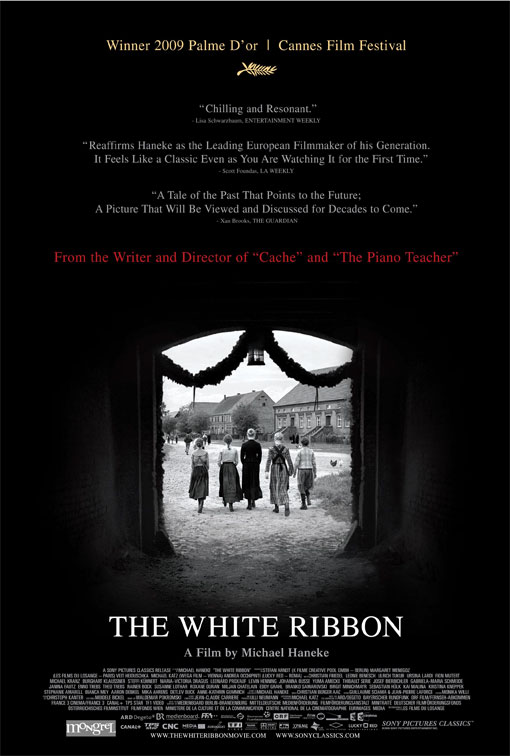
The White Ribbon (Das weisse Band - Eine deutsche Kindergeschichte)


The White Ribbon is a quiet and disturbing allegory set in a farming village in the rural Germany just some years before the World War I. The director Michael Heneke, known for his patient, methodological and detached style of filmmaking, tells a story of an array of strange events, accidents and murders that led to distrust and fear within the seemingly peaceful community.

The film is narrated by an unnamed school teacher in his old age now, recalling these strange events that happen in the village during his stay long time ago. The village is quiet and orderly, half of the habitants work for the baron who owns most of the land. At the beginning the village doctor was injured when his horse was tripped by a wire purposely set by someone. Accident happened in the barn which was burned later. Violence and tortured were exercised on some kids. Who was responsible? There are some hints, the truth seems palpable but we are never sure.

The fear of suspicion grows within the community as well as in us. We are given as little information as the characters receive. Can we trust the characters? There is no real emotion beyond their zombielike faces. Expression of oneself seems impossible within the power structure of this miniature society. Those who have spoken their own thoughts are considered threatening and are threatened by other members. Our only trustee is the school teacher. A hint of human touch occasionally flashes upon his face, and especially in his relationship with the baron's babysitter Eva. By the end of the film, there is no revelation of the looming villain, and that is beside the point of the film. The protagonist is the social dysfunction and the dread of living in it.

One might connect the story to the Nazi and fascism, but the film is really about a monarchy and the rebellion. The village is ruled by the riches - the baron, the pastor and the doctor. Under their rules, the villagers have no choice but to submit to their power. There is no escape, at least that's what the isolating landscape suggests. Those who choose to rebel are dysfunctional, sick or sinned, said the pastor and doctor. What is lurking behind the seemingly peaceful life is a savage revolution against the throne, using method inherited from the seniors.

This is a rare branch of film that is not set out to be liked or disliked. It intends to be appreciated like an essay or experiment. It asks you to confront a problem without giving away any solution. The film simply illustrates a situation like a bare fact. It won't work without the stunning black and white photography, which immediately separates its world from ours, creating a sense of detachment. Like his previous film Caché, Michael Heneke created a long and painfully slow film that absorbs you into its scenery and atmosphere, that is if you sit tight all the way until the end.

T.

2010年4月7日 星期三

HKIFF - 〈前度〉EX

HKIFF - 〈前度〉EX


周怡、漂亮名字的主人
卻是個如妖精般的女人

與其說她不知道自己的人生目標
說她是個自私而不自覺的女孩想必更為貼切

有關於她的現任,倒是說甚麼都動輒得咎
離開了她的前度好過渡到去新工作、新女友的生活
又要看不順眼攪風攪雨
就是暗裡傾慕她的男孩,也不見得有放過的必要
持靚行兇,一併挑逗無誤

和前度的相遇上的尷尬、浪漫或是曖昧不明
濃縮在那兩天左右的時間
給了眾人重新審視自己的心的機會和必要

不知道是我不夠「青春」了,還是從根本對故事認同不來
看畢90多分鐘的電影,實在半點都沒觸動得到
到了最後,周怡吻別了均平的好友“瀟灑的上機”
更是令人作嘔

+++

從製作上眾多的條件和細節看來
會覺得,導演大概想拍齣屬於當代的愛情片
更希望會是比較漂亮的一類(相比 我的最愛 系列)

是的!
如人物的設定、均平家的佈置都「甚有品味」
(如經典的電影海報、書籍、Lomography 相機、英國鐵路地圖等)

可就是因為這樣,我卻更不能接受畫面上的瑕疵
不知是否作後期的時間不夠
數碼調色明顯做得甚為倉促
就算不介意有時候 contrast 太大,令暗位沒 detail
有時候 highlight 位置太重手,令畫面爛了
好一兩個鏡頭還令阿嬌看來滿臉面油

+++

要說的可能還不少
在回家時,卻聽到小巴後座的三個小妹妹興高彩烈的討論劇情
就可能顯得是我的問題吧!
但有些標準,請不要隨便容易捨棄
畢竟觀眾是有眼見

我猜

還是繼續喜歡屬於我年代,最精彩的 - 12 夜
這溫軟、流麗、又甚有睿智的港產愛情片

edwin

2010年4月3日 星期六

HKIFF - 京都太秦物語

HKIFF - 京都太秦物語


由 山田洋次 和 阿部勉 聯合執導
加上由廿多個大學電影系學生,和商店街眾多的居民和老闆的協力拍成
與其說是電影作品,更像是給京都太秦這地方的情書一封


這毫不顯眼的鄉村小鎮
在日本電影史上卻擁有著不平凡的過去
它正是50-70年代日本電影發展迅速的期間
松竹映畫的一個主要片場,經典的 羅生門 也在這取景拍攝
然而,在松竹映畫近年的減產下
京都太秦也續漸回歸到本來古老平靜的面貌

片首從半紀錄片的形式開始
介紹過這片土地的背景和一些人物的訪談
便來到了發生在京子身上的戀愛一課

成為了兒時夢想 - 大學圖書館管理員的京子
有著青梅竹馬、希望成為出色笑匠的男友康太
可在努力過後的回報總不成正比
關於二人,事業和愛情路上也在徬徨找不到出口時候
京子卻受到從東京來到、大學的語文講師的熱烈追求

好一番的思前想後,所有事情都平靜得到了歸宿
我卻會好願意相信,這個思想和情感上的洗禮
醞釀的,正準備在京子心裡爆發呢!

從片末的 Q&A section 知道
(導演阿部勉 和演員海老瀨花出席)
聯合執導的 山田洋次 ,他真正介入製作的過程並不怎多
低調的細膩情感和人文關懷的痕跡,卻俯仰皆是

我想,他本人不就如京都太秦般
都已為當代電影提交過好不重要的深遠影響和貢獻了
好高興在這年的電影節看到了它

edwin